Monday, November 21, 2011

Rationing winter grazing

There's still lots of green grass in this pasture.

I tried to get a ground view of this grass to show that's it's still about 8 inches deep. There's still lots of green despite two hard frosts lately. This photo was taken on Nov. 19.


You can see the summer grasses have pretty much withered and died. I'm no plant expert but I'm guessing the green grass is fescue or a perennial rye. 


This pasture is lying idle for now. The main doe herd is about a quarter mile away on a pasture that has practically no green left. They're trimming up the sage brush and eating lots of falling leaves. There are still some acorns to be had.


I put out a couple small molasses protein blocks, but the goats are barely eating on them. That shows they're still getting pretty good nutrition in the woods. If they can make a living out there for another few weeks, I can keep stockpiling the grass in the photo above until around Christmas. 

Goats getting their head stuck in fence

These twin doelings do everything together, even getting their heads stuck in the fence.


The goats that get their heads stuck in the fence seem to do it for no reason -- and do it over and over. But I've never had a set of twins that consistently get their heads stuck -- together. And if you look at the ground, they have the same dry leaves on both sides of the fence if they're looking for a snack.

Thank goodness I don't have a lot of the 6x6 field fencing, Most of my pastures are electric fencing or 6x12 field fencing. 


Wednesday, November 9, 2011

Tree makes precision strike on gate

Gusting winds Tuesday afternoon blew over a dead tree that I had been watching for awhile. I knew the tree was getting rotten; dead limbs had been falling off for awhile. I had not cut it down yet because of its close proximity to two pasture fences, a catch pen and a goat shed. I hadn't figured out how to take it down without damaging something. Mother Nature took care of the problem for me with precision that few loggers possess.

This rotten tree fell between the two metal gate posts
and destroyed the gate. The shed at left escaped damage.
The tree took out a small gate, but completely missed the shed. With a chainsaw and a cattle panel, the damage was repaired in less than an hour. 


I'm really glad the goats were on the other side of the small pasture when the tree fell. This herd is made up of own daughters of Nick, Onyx and Rusty.

"G" and his girls survey the damage after a tree fell into their pasture.
Fortunately the tree didn't hit any of the goats. "G" made use of a broken 
limb 
to scratch between his horns.

Tuesday, November 8, 2011

Time to pull bucks off the does

These 100% New Zealand Kiko yearlings have been with a buck for 
the past month and a half. The buck (hiding in the rear) 
is an Onyx son 
owned by Rittenhouse Kikos. His dam is 
ECR Hanky Panky (Nick x JTV Queen).
I started pulling bucks out of the breeding pastures last weekend. The first group was this Onyx son and his girls. They had been in a small pasture since September and had no supplement (or any other attention) during that entire time. I ran the girls through the chute and checked their eyelids. Not a single doe needed deworming so I moved them into another pasture and put "HP" into a billy pen. He's done his job for the year (hopefully).

Cream of the Crop fun for family

Egypt Creek Ranch has been a part of every Cream of the Crop Kiko Production Sale since it began in 2008. I partner with Goat Hill Kikos of Porum, Okla., to put on the sale and usually have a half dozen or so guest consignors. To read about the sale, click here


I have enjoyed my annual trips to Corydon, Ind., where the sale is held. It's a nice little town with lots of sights and is always decorated for fall and Halloween during our sale time. This year my daughter Lindley and her family went, too. We needed the help and they were ready for a vacation so it worked out for all of us. Below are some photos from the trip.


Lindley with husband, Stephen Daniel;
their baby Lane; and 3-year-old nephew, Grayson.

Some our percentage Kikos.

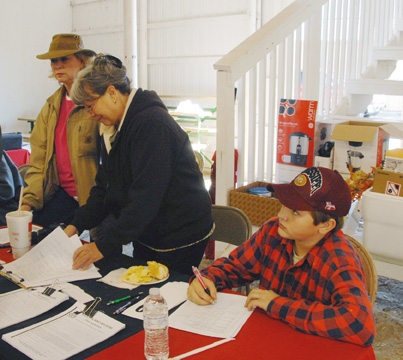
Grandson Rylan helps at the registration desk with (from left)
Deb Johnson of Windy Hills Kikos and Karen Brown
of the National Kiko Registry.

Monday, October 24, 2011

ECR Rusty Kat consigned to Cream of Crop

ECR Rusty Kat, an ECR Rusty son out of a Sports Kat daughter, is back home from the Western Illinois University Buck Performance Test. Rusty Kat finished in the middle of the pack with an overall average daily gain (ADG) of .39 pounds per day. His best performance was his feed efficiency of 4.33 (second best in the test), which means he gained 1 pound for every 4.33 pounds of feed consumed. You can tell by looking at the photos below that he takes a lot after his maternal grandsire, Sports Kat, with the stockiness and muscling, even on the rump. Rusty Kat was born March 8, 2011.

Rusty Kat, a 100% New Zealand Kiko, is consigned to the Cream of the Crop Kiko Production Sale (Lot #53) scheduled for Saturday, Oct. 29, at 1 p.m. at the Harrison County Fairgrounds in Corydon, Ind. Click here for pictures of some of my other consignments to the sale. 


Tuesday, October 11, 2011

Acorns are a part of our goats' diet

Acorns can supplement a goat's diet in the fall.

These does are pawing underneath oak trees looking for treats.

Found one!
I've heard supposed experts say that acorns will kill goats. I guess if they ate too many at one time they might, but that could be said of anything in their diet. Acorns have always played a part in our goats' diets. Every fall when the acorns begin to fall, you'll see the goats running from tree to tree to nibble on the tasty nuts.


I've had ranchers in Texas tell me that a large acorn crop helps give the goats a nutritional boost at breeding time, which can help conception rates. Others have told me that the tannic acid in acorns acts like a natural dewormer and that is why goats look so slick and healthy in the fall.


How true all of this is, I don't know. But I do know that my goats have been eating acorns for many, many years with no ill effects. The acorns this year are tiny compared to some years — probably because our lack of rain. Surprisingly, other foodstuffs, such as persimmons and muscadines, had bountiful crops. So our goats have had a variety of tasty treats this fall — which means a lot of free nutrition. (I took the above photos on my way to the office this morning.)


While doing research, I was reminded that humans have been eating acorns for thousands of years. Acorns were a large part of the Native American diet. They knew how to soak them to remove the tannins and used the the nuts in a variety of ways. Click here for an article on how you can prepare your own acorns for safe consumption.