Wednesday, February 22, 2012

New guardian puppy needs to learn some manners

You can see the bloody spots where the puppy apparently 
tried to pull the kid's ears and ripped the skin.
Introducing a new guardian dog can be tricky, especially a young dog that still wants to be playful with the goats. This Great Pyrenees puppy's mother was an older rescue dog who spent most of her time under the back porch; the father is our best male guardian. We have high hopes for him. He has been in the pasture with about 30 does ranging from 10 months to 2 years old. He'll occasionally chase a goat but they'll butt at him or just quit running and he loses interest.


Most of this playfulness has been harmless, but I am always worried about a new dog when kidding season arrives. You never know how the new guardian is going to react around kids, and I've had a couple bad experiences. One year we had a guardian that was so protective of the kids, he wouldn't let the mothers get near them. I think some of the older mom's finally explained to him who was boss.


Another time we had a guardian that tried to help the mothers clean up the new kids. Trouble is he licked too hard, tearing open the stomachs of several kids before we figured out what was happening. He was quickly disposed of.


I watched this newest puppy interact with the first kid born in his pasture. He tried to be too playful, chasing and knocking over the kid. The mom stepped in and I was hoping she would give the puppy a good pounding and teach him a lesson. She was young and, I think, a little too shy. She walked between the kid and puppy to separate them, and the puppy left them along. I hoped she would take care of the kid overnight and not let the puppy hurt it.


No such luck. The next morning the kid was soaking wet from the rain during the night. I guess the puppy had kept it chased out of the barn. And the kid had bloody ears from the puppy pulling on them with his teeth. I was as mad at the momma goat as I was at the puppy. A good head-butt by the momma would have taught the puppy to leave the kid alone.


The kid got a case of pneumonia from the night in the rain. A couple days of Nuflor and Nutri-Drench got him back on his feet. I put antibiotic salve on the ears and they seem have healed OK.


As for the puppy, he has a new home. I moved him across the road to the yearling buck pasture. He hasn't bonded with them to the point where he'll follow them out in the morning, but he doesn't chase and bite on them. Those guys are a little more intimidating than a mom and her baby. 


As the pup matures, we'll try him again with some bigger kids and see how he does. Typically, my Great Pyrenees pups have matured faster than some breeds I've read about. I'll give him a few more months and see how he progresses.


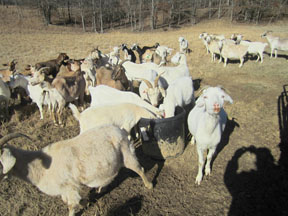
The pup isn't so quick to try and be playful with his new
pasturemates, seven yearling Kiko bucks.

Wednesday, February 8, 2012

What to do for a snotty nose

Notice the green discharge from his nose and eyes. 
Early this morning I noticed one of my yearling bucks standing off by himself in the pasture. Anytime I see a goat off by itself, I get nervous and wonder what's wrong. I walked out and as soon as I got close I could see the discharge running out of his nose. I don't worry about a clear discharge; its usually an allergy. (Every spring when the pine pollen starts filling the air, I and my goats all start sneezing and blowing our noses.)

On this morning the goat's discharge was a dark color, which can mean pneumonia. It also means you do not want to waste any time or take any chances. These situations always remind me of Greg Christiansen's Rule #355. Greg raises goats and manages Grandview Livestock in eastern Kansas. A few years ago he kept a diary during his kidding season and a condensed version of the diary was reprinted in Farm and Ranch Living Magazine. In the diary, he talks about Rule #355:


"We have rule #355 because number 355 kid didn’t look quite right one night but I thought I would check him the next day.  He didn’t make it through the night.  After you do this a while you get to know the look that says, you better do something for me if you want me to be here tomorrow."

I think we've all had that experience. So when a goat doesn't look or act just right, the producer can usually tell when action is needed. If a goat has scours, I usually give it 12-24 hours to get over it on his own. But if dark snot and runny eyes means there is a possibility of pneumonia, I'm going to treat it quickly because the goat can be dead within a day.

His nose and eyes were dry by lunchtime.
I brought the buck to the barn and gave him 4 cc's of Nuflor. I gave him some fresh water, a little feed and a flake of hay. I came back and checked on him at lunchtime and he was much better — a little weak eyed, but his nose wasn't running and his eyes had dried up. He had been in the hay feeder enough to clean all the buggers off his nose! 


I'll give him another dose of Nuflor tomorrow morning and go ahead and give him his pneumonia vaccination booster. If he's still doing OK tomorrow afternoon, he'll go back into the yearling billy pen.


Super Bowl Sunday with Bill & Brenda Moore

Bill & Brenda Moore — February 2012

For the past several years I have taken a few days off to go to Jasper, Ga., and spend Super Bowl Sunday with Bill & Brenda Moore. Bill & Brenda operated BBM Kikos — one of the best known operations in the business — for many years. Both of them had health challenges a few years ago and had to disperse their herd. As you can see in the photo above, they are both doing well and looking great.


"Sometimes I wish we still had goats so we would have something to do," Brenda told me. But she and Bill agreed it was nice not to have to check on babies and feed goats in cold weather.


They still keep in touch with many of their goat-industry friends and try to attend a few goat functions. It seems once you have raised goats for awhile, it's hard to get them out of your system.


Wednesday, February 1, 2012

Last roundup before kidding season begins

The goats gather around the 4-wheeler as I call them out 
of the brush and woods (below) in preparation for the trip to the barn.

The kids should be arriving in less than a month, so I took advantage of this week's warm weather to round up the does and give them their annual boosters for CD&T and pneumonia. I also vaccinate for CL, but I don't do that while they're pregnant; the shot can make them pretty sore and I don't want to subject them to any unnecessary stress. The pneumonia vaccination makes them limp for a day, but in our humid climate, it's worth the risk to make sure they are vaccinated.


I also don't like to deworm does during late-term pregnancy. I haven't seen any scientific evidence that such deworming can harm the fetus or cause abortion, but some folks say it can happen. So again, I don't want to take a chance that I don't have to. We checked the eyes on 52 does yesterday and dewormed only two — Kiko crossbreds who were both over 6 years old. 


Last week I began feeding these does each a half pound of 20% cattle cubes. I haven't purchased the goats any hay this season, just letting them eat stockpiled grasses, dried weeds, acorns and fallen leaves.  There's no way to determine their protein intake, so for a few cents a day I don't mind providing the cattle cubes as insurance during these last few weeks of pregnancy. I chose the cubes because the pasture where these goats are located has no facilities, including no feed troughs. I can drive back to the pasture and dump the cubes on the ground.


Penned up and ready for working.
A beautiful sight: Lots of developing udders!

Mild weather has mixed blessings

Thick green grass is growing in many areas. This photo was taken on Jan. 29.
This has been a crazy winter here in northwest Mississippi. First, we got two snows in November and now we've had milder than normal temperatures. I've got green grass and spring flowers popping up everywhere. The goats have enjoyed the fresh grass but weather this mild can cause problems come summertime. With no really freezing weather, the fire ants seem ready to come out in full force and we've even had a few mosquitoes on the back porch. With no real winter to set them back, I'm afraid a whole host of pests, including most goat parasites, will be a challenge this year.

These jonquils were blooming at the end of January. Do
you know the difference between jonquils, daffofils and

Fire ant hills are starting to pop up. Normally you
get a good freeze this time of year to help kill back
the fire ant population.

Thursday, January 12, 2012

Big fencing plans

While adding acreage to the ranch over the years, my goal was to complete a permanent fence around the entire property. After 15 years, I still haven't reached that goal, but all I am lacking are two parcels that are separated from the main ranch: 20 acres on the other side of a blacktop road and 11 acres across a creek. The 11 acres has a barbed wire fence and can hold my daughter and son-in-law's horses. It wouldn't hold goats. The 20 acres is a pine woodlot and has no fences at all. For now, those two parcels will stay as they are.

The main ranch property does have a complete perimeter fence of 48-inch woven goat wire with the 12-inch stays to keep horns from getting caught. I have done some cross-fencing with the woven wire and a good bit of 6-strand high-tensile. Still, my paddocks are way too big for efficient managed grazing. It's time to start doing some more cross fencing. This time, I'm going to use PowerFlex's high-tensile woven wire and offset hot wires. 

I recently visited PowerFlex's headquarters in Seymour, Mo., and picked up a load of fencing, fiberglass posts, insulators and all the accessories needed to build a permanent electric fence.

30 rolls of wire should keep me (and any friends or family
I can recruit) busy for the next year or so.

The aerial map below shows my present and future fence. The perimeter yellow line is completed with most of the interior yellow lines remaining to be done. The red lines are presently a combination of permanent and temporary electric fencing. This electric fence will be renovated into 16-foot lanes so that we can easily move goats to any part of the ranch without having to go through any paddocks or pastures. The big blue dots represent holding/sorting pens. This will be a work in progress, but I will try to keep readers updated as we make improvements.

Wednesday, January 4, 2012

Pregnant does moved onto new pasture

This herd of pregnant does is ready to move to new pasture.
The dry grass, leaves and acorns they've been living off of
has been supplemented with an all-natural 19% protein
horse tub. The horse tub was the only "all natural" tub I could
find in this area.


Back before Thanksgiving I was wondering how the grass would hold up in my stockpiled paddock. Click here to see the blog entry. Well, after numerous frosts and two snows, the grass has held up better than I could have expected. I moved the goats onto the stockpiled grass over the New Year weekend and they went right to work eating it. There is a lot of dry grass in the pasture but there is a lot of new grass greening up also. 

This is not a fancy pasture. Part of it is old hay pasture and part is cutover timber. None of the pasture has been improved. One of the biggest problems lately is under-grazing. The only goats on this pasture for the past 120 days was a group of 20 does and a buck during breeding season. They barely made a dent in the forage during the 45 days they were there. No goats have been on the pasture for the past 60 days.

This pasture has a lot of sage brush in it and I think that works as a windbreak and as insulation for the shorter grasses. If there is anything good to say about sage brush, I guess that is it. By the way, I had 2 tons per acre of lime applied to all my pastures a few years ago to try and help the sage brush problem. Didn't help much.

I had been saving this pasture for my biggest herd of pregnant does. They will be here during kidding, which begins near the end of February. I also moved the mineral feeders and the horse tubs to this pasture. This groups of goats will be low maintenance for the remainder of the winter.
The does dove right into the stockpiled grasses in this new pasture.


Some of the grass comes to the top of my boot.


There are about 30 acres in this pasture. The 44 pregnant does I moved
here should have plenty of nutrition until kidding season, which begins
the last week in February.