Wednesday, February 8, 2012

Super Bowl Sunday with Bill & Brenda Moore

Bill & Brenda Moore — February 2012

For the past several years I have taken a few days off to go to Jasper, Ga., and spend Super Bowl Sunday with Bill & Brenda Moore. Bill & Brenda operated BBM Kikos — one of the best known operations in the business — for many years. Both of them had health challenges a few years ago and had to disperse their herd. As you can see in the photo above, they are both doing well and looking great.


"Sometimes I wish we still had goats so we would have something to do," Brenda told me. But she and Bill agreed it was nice not to have to check on babies and feed goats in cold weather.


They still keep in touch with many of their goat-industry friends and try to attend a few goat functions. It seems once you have raised goats for awhile, it's hard to get them out of your system.


Wednesday, February 1, 2012

Last roundup before kidding season begins

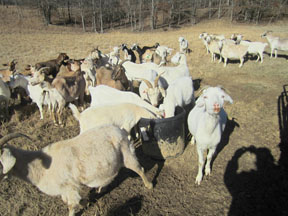
The goats gather around the 4-wheeler as I call them out 
of the brush and woods (below) in preparation for the trip to the barn.

The kids should be arriving in less than a month, so I took advantage of this week's warm weather to round up the does and give them their annual boosters for CD&T and pneumonia. I also vaccinate for CL, but I don't do that while they're pregnant; the shot can make them pretty sore and I don't want to subject them to any unnecessary stress. The pneumonia vaccination makes them limp for a day, but in our humid climate, it's worth the risk to make sure they are vaccinated.


I also don't like to deworm does during late-term pregnancy. I haven't seen any scientific evidence that such deworming can harm the fetus or cause abortion, but some folks say it can happen. So again, I don't want to take a chance that I don't have to. We checked the eyes on 52 does yesterday and dewormed only two — Kiko crossbreds who were both over 6 years old. 


Last week I began feeding these does each a half pound of 20% cattle cubes. I haven't purchased the goats any hay this season, just letting them eat stockpiled grasses, dried weeds, acorns and fallen leaves.  There's no way to determine their protein intake, so for a few cents a day I don't mind providing the cattle cubes as insurance during these last few weeks of pregnancy. I chose the cubes because the pasture where these goats are located has no facilities, including no feed troughs. I can drive back to the pasture and dump the cubes on the ground.


Penned up and ready for working.
A beautiful sight: Lots of developing udders!

Mild weather has mixed blessings

Thick green grass is growing in many areas. This photo was taken on Jan. 29.
This has been a crazy winter here in northwest Mississippi. First, we got two snows in November and now we've had milder than normal temperatures. I've got green grass and spring flowers popping up everywhere. The goats have enjoyed the fresh grass but weather this mild can cause problems come summertime. With no really freezing weather, the fire ants seem ready to come out in full force and we've even had a few mosquitoes on the back porch. With no real winter to set them back, I'm afraid a whole host of pests, including most goat parasites, will be a challenge this year.

These jonquils were blooming at the end of January. Do
you know the difference between jonquils, daffofils and

Fire ant hills are starting to pop up. Normally you
get a good freeze this time of year to help kill back
the fire ant population.

Thursday, January 12, 2012

Big fencing plans

While adding acreage to the ranch over the years, my goal was to complete a permanent fence around the entire property. After 15 years, I still haven't reached that goal, but all I am lacking are two parcels that are separated from the main ranch: 20 acres on the other side of a blacktop road and 11 acres across a creek. The 11 acres has a barbed wire fence and can hold my daughter and son-in-law's horses. It wouldn't hold goats. The 20 acres is a pine woodlot and has no fences at all. For now, those two parcels will stay as they are.

The main ranch property does have a complete perimeter fence of 48-inch woven goat wire with the 12-inch stays to keep horns from getting caught. I have done some cross-fencing with the woven wire and a good bit of 6-strand high-tensile. Still, my paddocks are way too big for efficient managed grazing. It's time to start doing some more cross fencing. This time, I'm going to use PowerFlex's high-tensile woven wire and offset hot wires. 

I recently visited PowerFlex's headquarters in Seymour, Mo., and picked up a load of fencing, fiberglass posts, insulators and all the accessories needed to build a permanent electric fence.

30 rolls of wire should keep me (and any friends or family
I can recruit) busy for the next year or so.

The aerial map below shows my present and future fence. The perimeter yellow line is completed with most of the interior yellow lines remaining to be done. The red lines are presently a combination of permanent and temporary electric fencing. This electric fence will be renovated into 16-foot lanes so that we can easily move goats to any part of the ranch without having to go through any paddocks or pastures. The big blue dots represent holding/sorting pens. This will be a work in progress, but I will try to keep readers updated as we make improvements.

Wednesday, January 4, 2012

Pregnant does moved onto new pasture

This herd of pregnant does is ready to move to new pasture.
The dry grass, leaves and acorns they've been living off of
has been supplemented with an all-natural 19% protein
horse tub. The horse tub was the only "all natural" tub I could
find in this area.


Back before Thanksgiving I was wondering how the grass would hold up in my stockpiled paddock. Click here to see the blog entry. Well, after numerous frosts and two snows, the grass has held up better than I could have expected. I moved the goats onto the stockpiled grass over the New Year weekend and they went right to work eating it. There is a lot of dry grass in the pasture but there is a lot of new grass greening up also. 

This is not a fancy pasture. Part of it is old hay pasture and part is cutover timber. None of the pasture has been improved. One of the biggest problems lately is under-grazing. The only goats on this pasture for the past 120 days was a group of 20 does and a buck during breeding season. They barely made a dent in the forage during the 45 days they were there. No goats have been on the pasture for the past 60 days.

This pasture has a lot of sage brush in it and I think that works as a windbreak and as insulation for the shorter grasses. If there is anything good to say about sage brush, I guess that is it. By the way, I had 2 tons per acre of lime applied to all my pastures a few years ago to try and help the sage brush problem. Didn't help much.

I had been saving this pasture for my biggest herd of pregnant does. They will be here during kidding, which begins near the end of February. I also moved the mineral feeders and the horse tubs to this pasture. This groups of goats will be low maintenance for the remainder of the winter.
The does dove right into the stockpiled grasses in this new pasture.


Some of the grass comes to the top of my boot.


There are about 30 acres in this pasture. The 44 pregnant does I moved
here should have plenty of nutrition until kidding season, which begins
the last week in February. 

Tuesday, December 20, 2011

Two snows and it's not even winter!

We can have some bad winter weather here in northwest Mississippi, but snow in November and early December is almost unheard of. Two snows is unprecedented. Our first snow in November was just a good dusting, about a half-inch accumulation. But on Dec. 7 we had more than two inches.  I know that's not even worth mentioning in some parts of the country, but that's a big snow for this early. If we get snow, it's usually in January or February.


There's not enough shed space for all the goats so I just keep them locked out. I didn't buy them any hay this year so it took them a little while to figure out they had to scratch through the snow to find some grass. The snow melted over the next two days and the goats made it just fine.

The goats head out into the snow looking for something to eat.

ECR Rusty, who will turn 10 years old on Feb. 12,
seemed to enjoy playing in the snow.

Cooking a holiday goat

For Thanksgiving this year I decided to cook a goat. I prepare goat meat several times a year, usually at family gatherings so that folks can get a "taste" of what we do here on the farm. I had been planning this for awhile, so I had a young wether that had never been dewormed or medicated. 

I slaughter similar to the traditional Halal manner. I use a  well sharpened knife to make a swift, deep incision that cuts the front of the throat, the carotid artery, wind pipe and jugular veins. I also say a brief prayer that seems to calm me and the goat. The goats never jump or cry, and quickly bleed out and are ready for processing. I then use a chain and pulley and an antique singletree to hang the carcass for skinning.

I won't go into the details of skinning a goat and removing the offal. The best advice I can offer is just do it if you want to try slaughtering a goat on your own. I grew up on this farm where each year we slaughtered hogs and cattle, so I had a pretty good working knowledge of the slaughtering process. Believe me, goats are a whole lot easier to process than hogs or cattle. 

I've got the carcass hanging and ready to skin.
Grandson Rylan washes the carcass before we cut it up.
This is the pile of meat we ended up with, about
15 pounds of bone-in meat.

With the meat from this small goat, I prepared two dishes. The easiest was a simple roast. I took the two hindquarters, rubbed them with salt and pepper, put them into a roasting pan with plenty of water and a chopped up onion, and let it bake for about 4 hours at 200 degrees. The meat is tender and retains the unique goat flavor. Folks ask me what goat tastes like. To me it doesn't taste like pork, beef or lamb. It has it's own flavor. I tell people it tastes like goat!


The rest of the goat I put into a large stew pot and prepared to make curry. This included the front legs, the neck, back and even the ribs. I used a meat cleaver to break the front leg bones so that the marrow could melt out and add flavor to the broth. At the bottom of this post is a "real" recipe for making curry. Here is the way I did it:


Into the pot with the meat and bones I put 4 Tbs of curry powder, 1 tsp. of cumin, 1 Tbs of Jamaican Allspice, 1 chopped onion, 1 tsp garlic powder, 1 tsp. black pepper and 1 tsp salt. I covered the meat with water and let it boil for about 3 hours, adding water as needed to keep the meat covered.


Once the meat began to fall off the bones, I drained off the broth into a separate container. I then deboned the meat, salvaging every morsel I could off the leg bones, back bones and even stripping out the small rib bones. I chopped the larger pieces of meat into bite-size cubes. (This is also the time I'm continuously taste-testing the spicy meat!)


Because this dish was being prepared for a family gathering, I wanted it to be easy to serve. I made a pot of rice and to this I added the chopped curry meat and added some of the broth for more flavor. One of the most important ingredients for "real" curry is a Scotch bonnet pepper. These hot peppers add the flame and a unique flavor to the curry recipe. I didn't have access to this pepper, so I added a Tbs of Nuclear Hell Hot Sauce, the hottest stuff in our kitchen. 


The curry was served in a large casserole dish and the roasted goat was served sliced on a platter with a bottle of Corky's Barbecue Sauce on the side. The two dishes looked quite nice there next to the turkey and ham, and tasted pretty good, too.

Curry Goat

Recipe courtesy Gregory Jolliff
Show: The Best OfEpisode: Tropical Drinks
ed 5 stars out of 5

Total Time:
--

Yield:
6 servings
Level:
Intermediat


Ingredients

  • 2 pounds goat meat (or lamb) without bones
  • 1 lime, juiced
  • 1 tablespoon salt
  • 1 teaspoon freshly ground black pepper
  • 1 Scotch bonnet pepper (any color), seeded and minced
  • 1/2 teaspoon dried thyme
  • 1/2 teaspoon ground allspice (dry pimento berries)
  • 3 tablespoons curry powder
  • 2 whole scallions, sliced
  • 1 onion, sliced
  • cloves garlic, minced
  • 1/4 cup vegetable oil
  • tomatoes, diced
  • 1/2 cup coconut milk (optional)
  • 7 cups water

Directions

Rinse goat meat well, rub lime juice over it (from 1/2 whole lime), place meat in a bowl, then add salt, black pepper, Scotch bonnet, thyme, allspice, curry powder, scallions, onion and garlic. Leave to marinate for at least 2 hours in the refrigerator, longer would be ideal. Heat the oil in a skillet until it is very hot, and saute the meat until golden brown. Then add the marinade, tomatoes and coconut milk, if using, and simmer for approximately 3 more minutes. Add water, reduce heat and allow to simmer for 2 to 3 hours stirring occasionally until meat is tender.