Tuesday, December 20, 2011

Two snows and it's not even winter!

We can have some bad winter weather here in northwest Mississippi, but snow in November and early December is almost unheard of. Two snows is unprecedented. Our first snow in November was just a good dusting, about a half-inch accumulation. But on Dec. 7 we had more than two inches.  I know that's not even worth mentioning in some parts of the country, but that's a big snow for this early. If we get snow, it's usually in January or February.


There's not enough shed space for all the goats so I just keep them locked out. I didn't buy them any hay this year so it took them a little while to figure out they had to scratch through the snow to find some grass. The snow melted over the next two days and the goats made it just fine.

The goats head out into the snow looking for something to eat.

ECR Rusty, who will turn 10 years old on Feb. 12,
seemed to enjoy playing in the snow.

Cooking a holiday goat

For Thanksgiving this year I decided to cook a goat. I prepare goat meat several times a year, usually at family gatherings so that folks can get a "taste" of what we do here on the farm. I had been planning this for awhile, so I had a young wether that had never been dewormed or medicated. 

I slaughter similar to the traditional Halal manner. I use a  well sharpened knife to make a swift, deep incision that cuts the front of the throat, the carotid artery, wind pipe and jugular veins. I also say a brief prayer that seems to calm me and the goat. The goats never jump or cry, and quickly bleed out and are ready for processing. I then use a chain and pulley and an antique singletree to hang the carcass for skinning.

I won't go into the details of skinning a goat and removing the offal. The best advice I can offer is just do it if you want to try slaughtering a goat on your own. I grew up on this farm where each year we slaughtered hogs and cattle, so I had a pretty good working knowledge of the slaughtering process. Believe me, goats are a whole lot easier to process than hogs or cattle. 

I've got the carcass hanging and ready to skin.
Grandson Rylan washes the carcass before we cut it up.
This is the pile of meat we ended up with, about
15 pounds of bone-in meat.

With the meat from this small goat, I prepared two dishes. The easiest was a simple roast. I took the two hindquarters, rubbed them with salt and pepper, put them into a roasting pan with plenty of water and a chopped up onion, and let it bake for about 4 hours at 200 degrees. The meat is tender and retains the unique goat flavor. Folks ask me what goat tastes like. To me it doesn't taste like pork, beef or lamb. It has it's own flavor. I tell people it tastes like goat!


The rest of the goat I put into a large stew pot and prepared to make curry. This included the front legs, the neck, back and even the ribs. I used a meat cleaver to break the front leg bones so that the marrow could melt out and add flavor to the broth. At the bottom of this post is a "real" recipe for making curry. Here is the way I did it:


Into the pot with the meat and bones I put 4 Tbs of curry powder, 1 tsp. of cumin, 1 Tbs of Jamaican Allspice, 1 chopped onion, 1 tsp garlic powder, 1 tsp. black pepper and 1 tsp salt. I covered the meat with water and let it boil for about 3 hours, adding water as needed to keep the meat covered.


Once the meat began to fall off the bones, I drained off the broth into a separate container. I then deboned the meat, salvaging every morsel I could off the leg bones, back bones and even stripping out the small rib bones. I chopped the larger pieces of meat into bite-size cubes. (This is also the time I'm continuously taste-testing the spicy meat!)


Because this dish was being prepared for a family gathering, I wanted it to be easy to serve. I made a pot of rice and to this I added the chopped curry meat and added some of the broth for more flavor. One of the most important ingredients for "real" curry is a Scotch bonnet pepper. These hot peppers add the flame and a unique flavor to the curry recipe. I didn't have access to this pepper, so I added a Tbs of Nuclear Hell Hot Sauce, the hottest stuff in our kitchen. 


The curry was served in a large casserole dish and the roasted goat was served sliced on a platter with a bottle of Corky's Barbecue Sauce on the side. The two dishes looked quite nice there next to the turkey and ham, and tasted pretty good, too.

Curry Goat

Recipe courtesy Gregory Jolliff
Show: The Best OfEpisode: Tropical Drinks
ed 5 stars out of 5

Total Time:
--

Yield:
6 servings
Level:
Intermediat


Ingredients

  • 2 pounds goat meat (or lamb) without bones
  • 1 lime, juiced
  • 1 tablespoon salt
  • 1 teaspoon freshly ground black pepper
  • 1 Scotch bonnet pepper (any color), seeded and minced
  • 1/2 teaspoon dried thyme
  • 1/2 teaspoon ground allspice (dry pimento berries)
  • 3 tablespoons curry powder
  • 2 whole scallions, sliced
  • 1 onion, sliced
  • cloves garlic, minced
  • 1/4 cup vegetable oil
  • tomatoes, diced
  • 1/2 cup coconut milk (optional)
  • 7 cups water

Directions

Rinse goat meat well, rub lime juice over it (from 1/2 whole lime), place meat in a bowl, then add salt, black pepper, Scotch bonnet, thyme, allspice, curry powder, scallions, onion and garlic. Leave to marinate for at least 2 hours in the refrigerator, longer would be ideal. Heat the oil in a skillet until it is very hot, and saute the meat until golden brown. Then add the marinade, tomatoes and coconut milk, if using, and simmer for approximately 3 more minutes. Add water, reduce heat and allow to simmer for 2 to 3 hours stirring occasionally until meat is tender.

Monday, November 21, 2011

Rationing winter grazing

There's still lots of green grass in this pasture.

I tried to get a ground view of this grass to show that's it's still about 8 inches deep. There's still lots of green despite two hard frosts lately. This photo was taken on Nov. 19.


You can see the summer grasses have pretty much withered and died. I'm no plant expert but I'm guessing the green grass is fescue or a perennial rye. 


This pasture is lying idle for now. The main doe herd is about a quarter mile away on a pasture that has practically no green left. They're trimming up the sage brush and eating lots of falling leaves. There are still some acorns to be had.


I put out a couple small molasses protein blocks, but the goats are barely eating on them. That shows they're still getting pretty good nutrition in the woods. If they can make a living out there for another few weeks, I can keep stockpiling the grass in the photo above until around Christmas. 

Goats getting their head stuck in fence

These twin doelings do everything together, even getting their heads stuck in the fence.


The goats that get their heads stuck in the fence seem to do it for no reason -- and do it over and over. But I've never had a set of twins that consistently get their heads stuck -- together. And if you look at the ground, they have the same dry leaves on both sides of the fence if they're looking for a snack.

Thank goodness I don't have a lot of the 6x6 field fencing, Most of my pastures are electric fencing or 6x12 field fencing. 


Wednesday, November 9, 2011

Tree makes precision strike on gate

Gusting winds Tuesday afternoon blew over a dead tree that I had been watching for awhile. I knew the tree was getting rotten; dead limbs had been falling off for awhile. I had not cut it down yet because of its close proximity to two pasture fences, a catch pen and a goat shed. I hadn't figured out how to take it down without damaging something. Mother Nature took care of the problem for me with precision that few loggers possess.

This rotten tree fell between the two metal gate posts
and destroyed the gate. The shed at left escaped damage.
The tree took out a small gate, but completely missed the shed. With a chainsaw and a cattle panel, the damage was repaired in less than an hour. 


I'm really glad the goats were on the other side of the small pasture when the tree fell. This herd is made up of own daughters of Nick, Onyx and Rusty.

"G" and his girls survey the damage after a tree fell into their pasture.
Fortunately the tree didn't hit any of the goats. "G" made use of a broken 
limb 
to scratch between his horns.

Tuesday, November 8, 2011

Time to pull bucks off the does

These 100% New Zealand Kiko yearlings have been with a buck for 
the past month and a half. The buck (hiding in the rear) 
is an Onyx son 
owned by Rittenhouse Kikos. His dam is 
ECR Hanky Panky (Nick x JTV Queen).
I started pulling bucks out of the breeding pastures last weekend. The first group was this Onyx son and his girls. They had been in a small pasture since September and had no supplement (or any other attention) during that entire time. I ran the girls through the chute and checked their eyelids. Not a single doe needed deworming so I moved them into another pasture and put "HP" into a billy pen. He's done his job for the year (hopefully).

Cream of the Crop fun for family

Egypt Creek Ranch has been a part of every Cream of the Crop Kiko Production Sale since it began in 2008. I partner with Goat Hill Kikos of Porum, Okla., to put on the sale and usually have a half dozen or so guest consignors. To read about the sale, click here


I have enjoyed my annual trips to Corydon, Ind., where the sale is held. It's a nice little town with lots of sights and is always decorated for fall and Halloween during our sale time. This year my daughter Lindley and her family went, too. We needed the help and they were ready for a vacation so it worked out for all of us. Below are some photos from the trip.


Lindley with husband, Stephen Daniel;
their baby Lane; and 3-year-old nephew, Grayson.

Some our percentage Kikos.

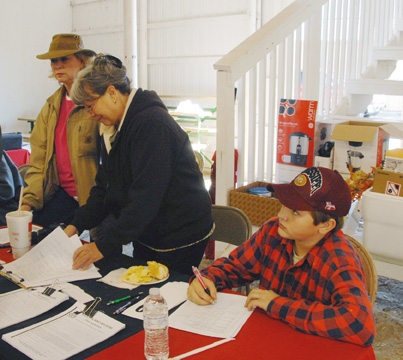
Grandson Rylan helps at the registration desk with (from left)
Deb Johnson of Windy Hills Kikos and Karen Brown
of the National Kiko Registry.