Friday, April 29, 2011

Fighting fire ants

The distinctive fire ant mound.
When I was a kid, I didn't know what a fire ant was. It wasn't until I was grown and lived in South Mississippi that I was exposed to this pest. Over the past few decades, however, this fiendish ant has steadily moved northward — and, I think, adapted to our colder winters.


Fire ants first came into the United States through the Port of Mobile in 1929 in dirt being used as ballast in a ship cruising from South America. From its launch pad in south Alabama, the ant has infested most of the Southern United States. 


I have heard that the fire ants' invasion was aided by the expansion of the U.S. highway system. As earth-moving equipment moved from one part of the country to another, fire ant nests were transported along with the dirt-caked machinery.
I have a theory that fire ants first arrived on our farm in the 1990s riding on pulpwood equipment.


There are no natural enemies to the imported fire ant, so chemical methods are the only tools we have to fight this invader. And the truth is this is a fight with no end. I have combatted the pest on properties in central Alabama and all sections of Mississippi for nearly 25 years. The best we can hope for is control — not extermination. No matter how many nests you kill, another always pops up.
The 25-lb. bag is the best bargain. We purchase it at the Tate County Co-op 
in Senatobia, Miss. 662-562-7811.


Each Spring my grandsons and I scout the pastures looking for fire ant mounds. We then treat each one with poison. For the past couple of years I have used Extinguish Professional Fire Ant Bait. I buy it in a 25-pound bag at my local co-op; this year the price is $65.


We use a large coffee container with a 
v-notch in the lid to administer the 
poison granules.


Counting our blessings

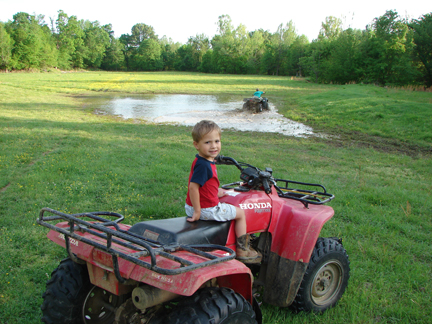
Grayson, almost 3, waits for Pawpaw to finish taking 
photos and give him a ride, while Landon, background, 
takes a spin in the mudhole.
I was planning to run photos of the downed trees on our farm, one of which took out a section of goat fence. But after witnessing all the damage in other parts of Mississippi, Alabama, Tennessee and Georgia, I decided my damage was insignificant in comparison. Instead, I'm counting my blessings today that my farm and family are still in one piece. I can fix my fence; loved ones can never be replaced.

Our prayers go out to the hundreds of people who lost homes, businesses and family members to the devastating tornadoes that crashed through our region this week. Hug your children, play with the grandkids and thank God you still have them to hold.

Tuesday, April 19, 2011

Moving mineral feeders


I moved two groups of goats onto new pastures over the weekend. The Kawasaki Mule makes it easy to move the big mineral feeders; they hang perfectly over the tailgate. In a matter of minutes, the goats and their minerals were moved.

I prefer a high-magnesium cattle mineral this time of year with all the new grass and clover. There's no scientific evidence that I know of that says this type of mineral is better for goats, but I was raised with a cattle background. We always used high mag mineral during the spring green up to help prevent grass tetany. 

Monday, April 18, 2011

It hurts!

This 100% NZ ECR Rusty son favors his left
leg after his pneumonia vaccination.
The pneumonia vaccine we use is rough on the kids and grown goats alike. They will limp on whichever shoulder the shot is given and most will go off feed for a day. They look and act pitiful, but the 24 hours' of misery they go through is well worth it (to me, anyway) for the protection they get from the disease. 


The correct term for the vaccination and the disease is actually pasturella instead of pneumonia. Our heat and high humidity here in the Deep South make pasturella a real killer in the summer time. We began the vaccinations about 7 years ago and rarely experience a death from respiratory infections. If the goats breathe easier, they grow better — and that makes me breathe easier.

Friday, April 15, 2011

A tale of two pastures


This photo that I took from along my driveway yesterday shows the difference that the stocking rate can make on a pasture. Readers of the Stockman Grass Farmer are familiar with management intensive grazing and the benefits it has on pasture grasses. 


In this case, I'm not exactly sure why the pasture at right is so much denser and healthier than the pasture on the left. The pasture on the right was grazed from late fall until April 11. This area of the pasture is also where the goats bedded down at night, did a lot of pooping and peeing and a lot of tromping down the grass. 


The pasture on the left had a low stocking rate all last year; if the stocking rate is high enough, the sage brush is nibbled down before it gets to the dry brush stage. Interestingly, the pasture on the left has had 2 tons per acre of lime applied in recent years; the pasture at right had none.

Thursday, April 14, 2011

New kid, great genetics

Lindley with Baby Lane.
Our daughter Lindley had her first baby yesterday afternoon. The big boy weighed 8 lbs.-7 ozs. and was 21 inches long. Scrap the newborn outfits -- the 3-month clothes fit just fine. Daddy Stephen was as relieved as Lindley when Lane finally arrived. Lane joins other goat ranchers in training: cousins Rylan, Landon, Grayson and Kade.

Tuesday, April 12, 2011

Vaccinations and ear tags

On Sunday evening we rounded up all the kids that had not been eartagged. Most of these kids are right at a month old, so it was time for their first vaccination shots, a dose of Valbazen for tapeworms and a dusting with Sevin dust for mites, lice and ticks. Rylan, my 10-year-old grandson, and I led, coaxed and pushed the group of mommas and babies the quarter-mile down the gravel road from their pasture to a small paddock near the barn. That way they would be handy when Roland and I got ready to work them Monday morning.

While they were in the small paddock, I was able to catch all of the 75% Kiko kids and put a green ear tag in each one. Once they were sorted out, I knew that everything else was 50% Kiko. The 50% girls got a blue tag in the right ear and 50% boys got a scrapie tag in the left ear.

I then ran all the mothers and kids into a catch pen and sorted the adults into one area and the kids into a holding stall. I then ran all the adults through the Sydell working chute for their monthly FAMACHA check. 


While I had the nannies corralled, I gave them all of their annual vaccination boosters at one time  (I wasn't sure when I would have an opportunity to round them up again!). 


The vaccines I use are manufactured by Colorado Serum and I purchase them from Register's Sheep and Goat Supply.


I vaccinated for:

  • CD&T — Essentials C + T
  • Pneumonia — Mannheimia Haemolytica-Pasteurella Multocida Bacterin
  • CL — Base-Bac

I also treated them with Synergized De-Lice for external parasites. The pneumonia and CL vaccines will make the animals limp and sometimes go off feed for a day, but I have never had any severe reactions.


The kids were vaccinated for CD&T and pneumonia. The pneumonia vaccine hurts bad enough, so I wait until later in the year to start the CL regimen of shots. The kids will get their second CD&T and pneumonia booster in 2-4 weeks.


Blue ear tags signify 50% Kiko does. These are ECR Rusty daughters.

Green ear tags signify 75% Kikos. Males are tagged in the left ear; girls in the right.

I use the free scrapie tags on the male kids that I know are destined for slaughter.